Guide
Landed cost: what your product really costs you
What you paid the supplier isn't what the product cost. Between freight, customs, currency and channel fees, the margin you thought you had may not exist.
This is the most expensive mistake an importing business makes: costing from the supplier invoice. The product lands at $10 and sells at "a 40% margin" which, once everything is added up, turns out to be 9%. The business looks profitable and the bank balance disagrees.
Landed cost is what one unit costs you sitting in your own storeroom, with every expense spread across it. Below is the full calculation, and then how Inventury does it without you rebuilding the spreadsheet every time the exchange rate moves.
The four layers nobody adds up
An honest cost has four layers, and each one gets forgotten for a different reason.
The supplier invoice is always remembered. Freight is half-remembered, because it arrives on another invoice weeks later. Customs and import duties get forgotten because the broker pays them and they read like "a cost of the month". And the channel fee isn't treated as a product cost at all, even though it comes out of the same margin.
- Supplier price, in their currency and at the rate on the day you paid
- Freight and insurance, spread across the units in the shipment
- Customs, duties and broker fees
- The fee of the platform you're selling on, which changes per channel
The calculation, with numbers
Take a shipment of 100 units at $10 each: a $1,000 invoice. Freight and insurance for the whole shipment cost $180. Customs and the broker, $220. Total outlay: $1,400 for 100 units, or $14 per unit sitting in your storeroom. Not $10.
Now the channel. Sell that unit at $25 in your shop and your margin is $11 — 44%. Sell it through a platform that keeps 15% and you receive $21.25, so the margin drops to $7.25 — 29%. Ship it too, at a $3 cost, and $4.25 is left — 17%.
Same product, same sticker price, three different margins. Which is why price isn't decided once; it's decided per channel.
The numbers are an example. What matters is the order: landed cost first, channel fee second, price only after that.
What Inventury does with this
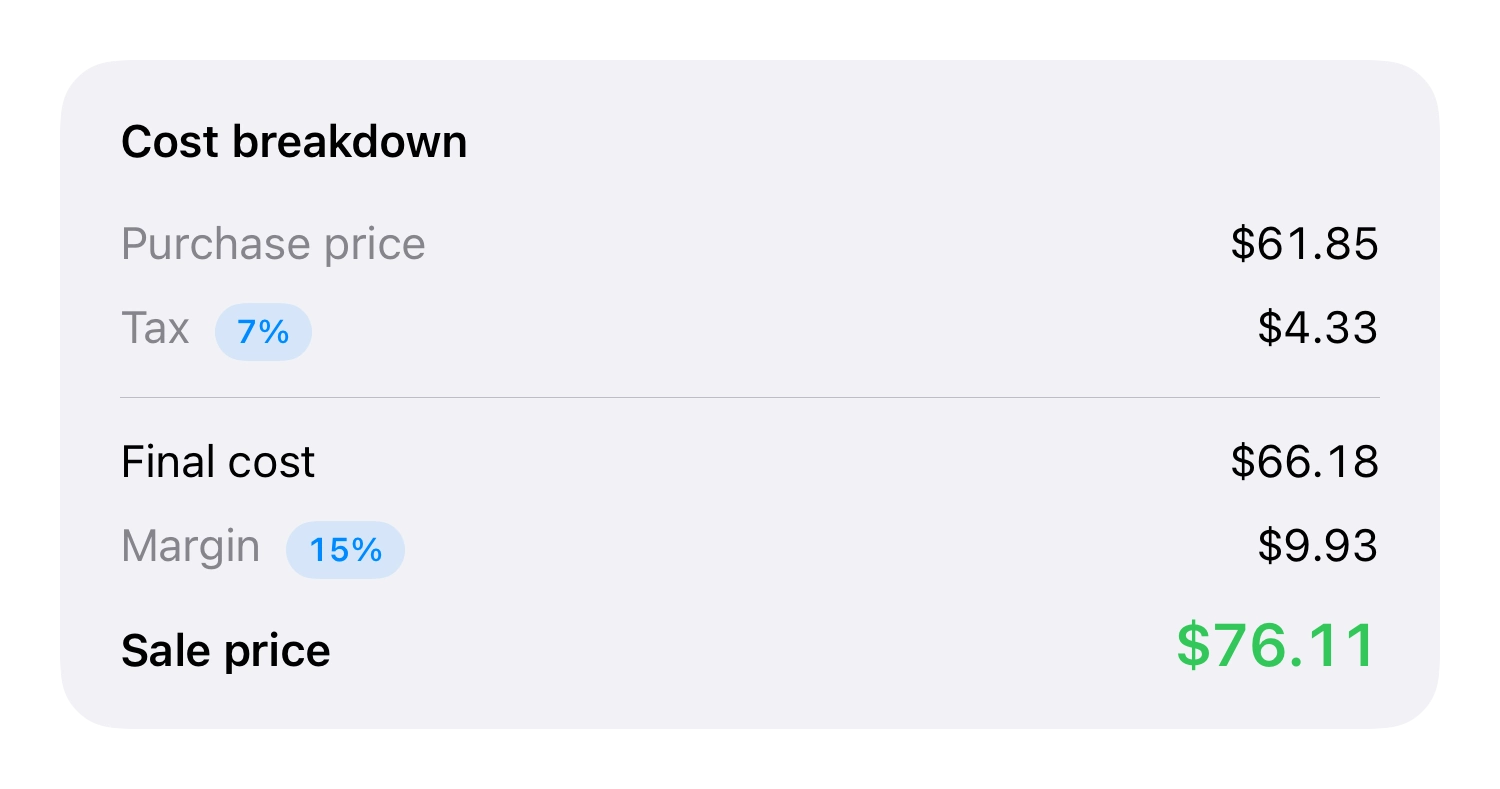
In the app an item doesn't have "a cost" — it has the expenses that make it up. You enter the invoice in the supplier's currency, add the shipment's freight and import costs, and the app spreads them across the units and gives you the real cost per unit.
From there you work backwards: name the margin you want and the app tells you the price you need on each channel, fee already deducted. Or the other way round — set the price you want to sell at and see the margin you're actually left with in each place.
- Multiple currencies, with their exchange rate
- Import costs spread per unit
- Channel fee deducted from the margin
- Suggested price per platform from a target margin
And then the report tells the truth
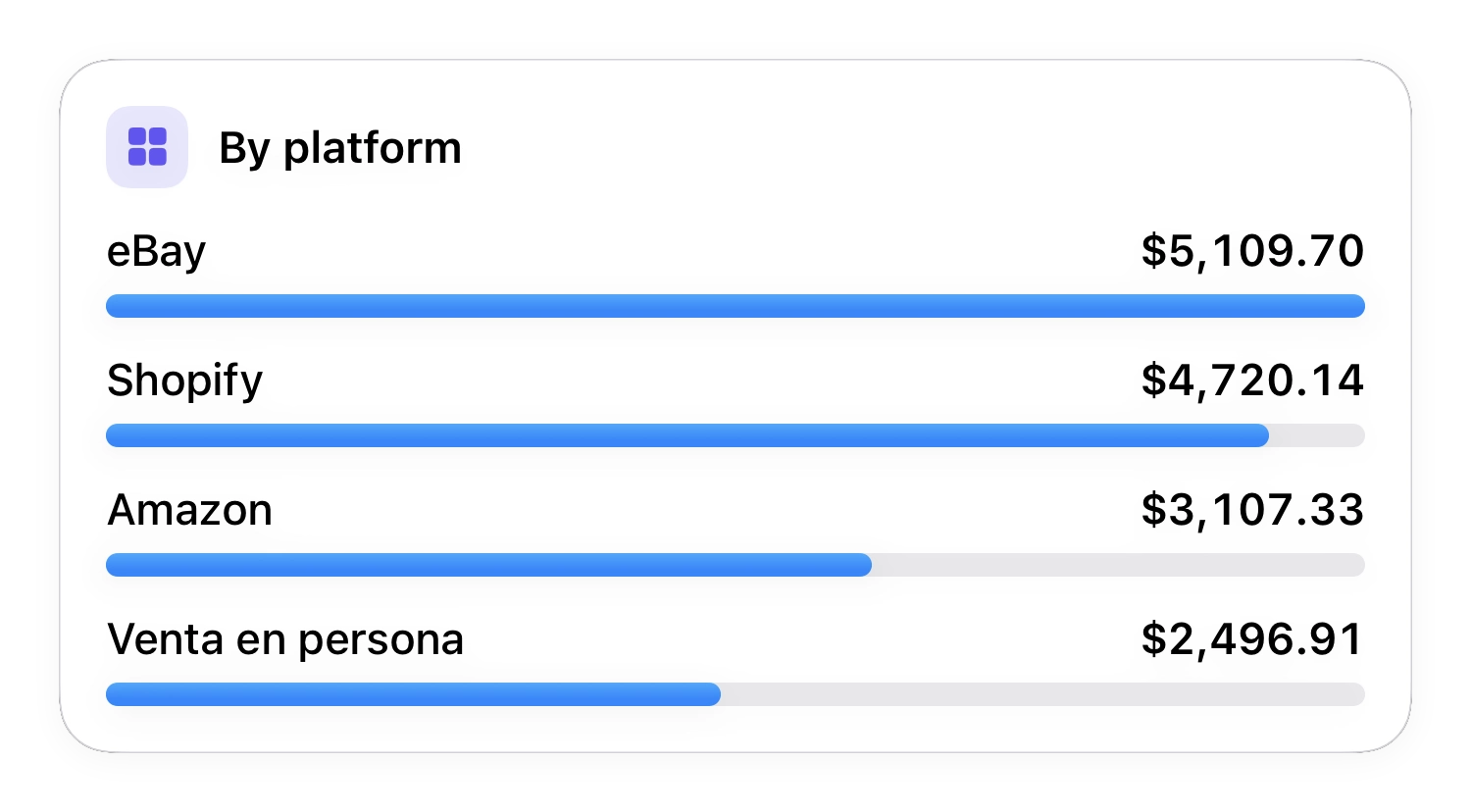
Once cost is set properly, reports stop being decorative. Margin per product is the real one, not the supplier invoice's. And the per-platform report shows something that tends to surprise people: the best seller isn't always the biggest earner.
That's the decision that pays for the work of costing properly — knowing which product to push on which channel, and which one you've been selling at a loss without noticing.
Frequent questions
What exactly is landed cost?
Everything one unit costs you sitting in your storeroom: the supplier price converted to your currency, plus freight, insurance, customs and broker fees, spread across the units in the shipment.
How do I split freight across different products in one shipment?
Split it in proportion to something that reflects what each product weighs or takes up: per unit if they're similar, or by value, weight or volume if they aren't. What matters is picking one criterion and sticking to it — changing it every shipment makes margins incomparable.
Exchange rates move weekly. Do I have to re-cost everything?
No. What you already bought doesn't get more expensive because the rate moved: it's costed at the rate on the day you paid. The new rate affects your next purchase, which is why it's worth checking the margin before each reorder.
Should sales tax go into the cost?
It depends on whether you recover it. If the tax is deductible for your business it isn't a product cost; if it isn't, it is. The practical rule: if it never comes back to you, it belongs in the cost.
Can I see the margin before I set the price?
Yes, in both directions. Start from the margin you want and see the price you need per channel, or start from the price and see the margin each channel leaves you.
Cost one product properly and see what's left
Costing is available on every plan, including the free one. Put in your most-imported product and compare it with what you thought it cost.